Should a social profile link to one landing page or a small link hub?
Someone visiting a business profile may want the product shown in its latest video. Another person may need opening hours or project examples. A long homepage does not automatically answer both questions, but an unnecessary link hub creates another decision. This guide concerns the destination of a profile link, not a promise of more social impressions. The business journeys shown in its diagrams are illustrative teaching examples.
List the intentions the profile creates
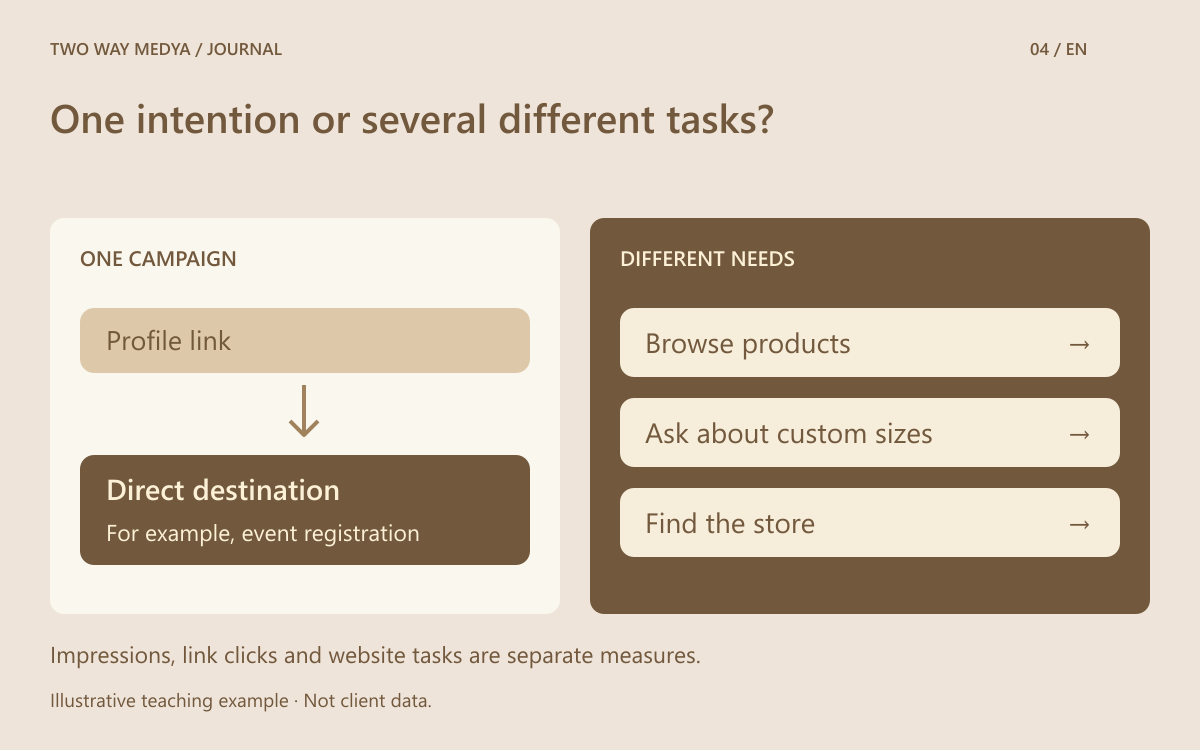
Review recent posts and actual questions. If people mainly need one event registration page, a direct link is a useful starting candidate. If product discovery, store information and custom enquiries coexist, a small menu may help. This is not a universal numerical rule. Write down the tasks your own content creates rather than adding another page simply because other brands have one.
Organise links around tasks
For an illustrative furniture brand, “Browse dining tables”, “Ask about custom sizes” and “Get directions” can be clearer than departmental labels. Match each name to the destination that actually opens. Do not automatically give the first position to the most expensive service; consider the next step expected from current content. Assign someone to maintain each link rather than treating the list as a permanent installation.
Translate an accessibility principle into labels
W3C’s explanation of link purpose calls for the purpose to be identifiable from the text or appropriate context. Avoid a series of identical “Click here” buttons. Supply meaningful accessible names for icon links. In the example menu, every row describes a task; decorative branding does not replace that explanation. For international visitors, translate the destination content as well as its menu label.
Continue the promise made by the post
If the profile promises a catalogue, make the route to it visible in the first screen. Do not send visitors from a service video into an unrelated promotion. Distinguish enduring campaigns from weekly content; changing one shared destination can also affect older posts. A short identity statement and clear choices may be sufficient. Avoid requiring visitors to watch another promotional film before they can act.
Measure the impressions goal in its own place
Increasing impressions can be an objective for social content, while opening a link hub is a separate website event. Do not present the hub design alone as the cause of increased platform impressions. Report profile visits, link clicks and completed website tasks separately. If several changes happened together, avoid assigning the result entirely to the destination page. Its purpose here is to turn existing interest into understandable choices.
Approve it with three mobile tasks
Ask a test reader to find the product featured in a post, the contact route and, when relevant, the other language version. Record hesitation without inventing a sales uplift. Regularly inspect expired campaigns, broken links and incorrect language destinations. Define social media management around shared ownership of the content, profile link and destination. A useful hub needs ongoing attention rather than a one-off list of buttons.
Frequently asked questions
How many links should a hub contain?
There is no fixed ideal. Select the distinct tasks that need to coexist, remove unnecessary choices and test the result with visitors.